The Last Scream: Inside Lamborghini's Battle to Save the Soul of Its Engine
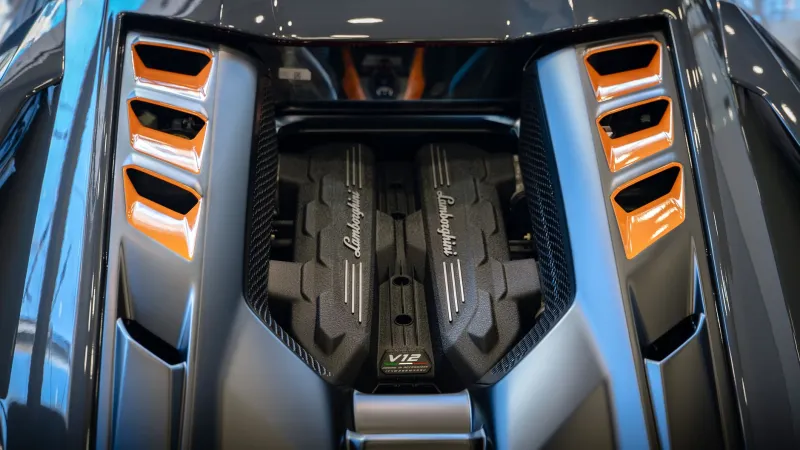
There is a moment, somewhere above 7,000 RPM in a naturally-aspirated Lamborghini V12, when the sound stops being a sound and becomes something closer to a physical event. American collectors who have experienced it — on a canyon road outside Los Angeles, on an empty stretch of Nevada highway, or at one of the country's premier track days — describe it with the reverence usually reserved for things that cannot be adequately explained. It is, by any measure, one of the defining sensory experiences in the automotive world. And it is, by the relentless logic of emissions legislation and electrification timelines, a finite resource.
The engineering war now unfolding inside Lamborghini's development facilities is not merely technical. It is philosophical, emotional, and in some respects existential. The question is not simply how to meet regulatory requirements — engineers solve regulatory requirements every day. The deeper question is whether anything essential survives the transition, and whether the answer even matters to the next generation of buyers.
What Makes a Lamborghini Engine a Lamborghini Engine
To understand what is at stake, it is worth examining precisely what the naturally-aspirated formula delivers that alternatives cannot easily replicate. The absence of forced induction means throttle response is essentially instantaneous — there is no turbo lag, no moment of mechanical hesitation between driver input and engine reaction. The power curve builds linearly and with increasing urgency as revs climb, rewarding those who push toward the redline with an exponential return on commitment.
The acoustic character is equally distinctive. Turbocharged engines, however powerful, produce a different kind of noise — more compressed, more industrial in timbre. Hybrid systems introduce electric whine and moments of eerie silence. The naturally-aspirated Lamborghini V10 and V12 units produce a sound that engineers describe as a function of combustion frequency, intake resonance, and exhaust tuning working in concert. Replicating that through artificial means — speaker systems, active exhaust manipulation — is technically possible and widely regarded, among serious collectors, as deeply unsatisfying.
The Hybrid Compromise and What It Actually Means
Lamborghini's current hybrid strategy, embodied in the Revuelto, represents the company's first serious attempt to graft electrification onto its performance philosophy without abandoning that philosophy entirely. The results are, by most objective measures, impressive. The Revuelto is faster, more efficient, and more tractable than the Aventador it replaced. The V12 still screams. The electric motors contribute torque rather than replace character.
But longtime owners are not universally convinced. Several American collectors who have transitioned from Aventadors to Revueltos speak candidly about a subtle but perceptible shift in the car's personality. The electric assistance introduces a layer of mediation between driver and drivetrain that was not previously present. The car is more capable; some argue it is less communicative. The distinction matters enormously to enthusiasts who value analog connection above raw performance metrics.
From an engineering perspective, the hybrid architecture was not chosen arbitrarily. It allows Lamborghini to meet increasingly stringent corporate average fuel economy standards in the US without abandoning internal combustion entirely — a regulatory tightrope that the company is walking with considerable technical sophistication. The additional electric torque also enables performance figures that naturally-aspirated engines alone could not achieve at this displacement. The engineering logic is sound. The emotional calculus is more complicated.
The Collector Community's Unspoken Anxiety
Among American Lamborghini collectors, there exists a quiet but growing preoccupation with what might be called preservation instinct. Auction results for late-model, low-mileage naturally-aspirated examples — particularly final-year Aventadors and well-preserved Huracáns — have shown meaningful appreciation that outpaces typical depreciation curves for modern supercars. This is not coincidental.
Collectors who have spent decades building relationships with dealers and attending marque-specific events speak of the naturally-aspirated era with an awareness that it is closing. Some are acquiring additional examples specifically to preserve the experience for personal use. Others are holding vehicles they might otherwise have cycled out of their collections, unwilling to surrender the last examples of an engineering approach they fear will not return.
This behavior has practical implications for the broader market. As the collector community increasingly treats naturally-aspirated Lamborghinis as finite assets rather than depreciating consumer goods, pricing dynamics shift accordingly. The cars that once represented the entry point to Lamborghini ownership are now being repositioned, quietly and organically, as collectibles.
What Lamborghini's Engineers Believe — and What They Won't Say Publicly
Engineers working within the brand's powertrain division are not naive about the trade-offs involved in electrification. Privately, those with long institutional memories acknowledge that the naturally-aspirated formula represents a kind of engineering purity that hybrid and electric architectures inherently complicate. The additional weight of battery systems, the complexity of managing two power sources simultaneously, and the challenge of maintaining a coherent driver experience across different powertrain modes are all genuine difficulties.
What the company communicates publicly is more optimistic, and not without basis. Lamborghini's engineers point to the Revuelto as evidence that hybridization need not be a capitulation — that done correctly, it can extend the performance envelope while preserving enough of the original character to satisfy serious drivers. The argument is credible. It is also, in the view of many collectors, incomplete.
The fully electric future that regulatory trends suggest is coming presents a categorically different challenge. Active exhaust systems and synthetic engine notes can approximate the Lamborghini experience in the same way that a photograph can approximate a landscape — technically accurate, experientially insufficient.
The Question Nobody Wants to Answer
Perhaps the most honest framing of Lamborghini's current predicament is this: the company is not choosing between performance and character. It is choosing between two definitions of character — one rooted in mechanical process, the other in outcome and capability. For a generation of buyers who discover Lamborghini through performance statistics and social media presence, the distinction may be irrelevant. For the American collectors who have built their enthusiast identities around the experience of a naturally-aspirated engine at full cry, it is the only distinction that matters.
Lamborghini has navigated existential challenges before. The transition from Ferruccio's ownership through multiple corporate parents, the near-bankruptcy of the 1970s and 1980s, the reinvention under Audi AG's stewardship — each represented a moment when the marque's survival required adaptation without surrender of identity. The electrification era may prove to be the most demanding version of that recurring test. Whether the engineers in Sant'Agata can pass it while preserving what makes a Lamborghini genuinely irreplaceable remains, for now, an open question.