Sant'Agata's Transatlantic Pivot: How American Tastes Are Quietly Rewriting the Lamborghini Formula
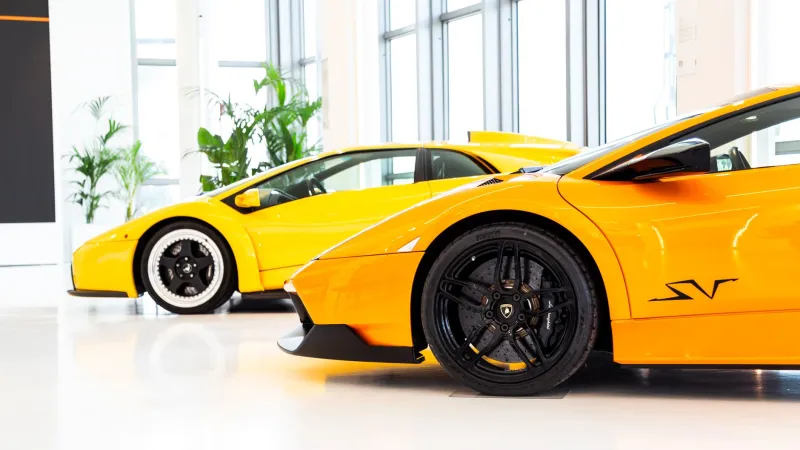
There is a version of Lamborghini that existed before America fell in love with it — raw, unfiltered, and aggressively indifferent to the comfort of its driver. The Miura did not coddle. The Countach did not apologize. These were machines conceived in a small Emilian town by engineers who answered to no demographic survey, no focus group, and certainly no overseas import regulation. They were Italian to their core, and their global appeal was almost incidental.
That era, many insiders argue, is over.
Today, the United States represents Lamborghini's single largest market by volume and revenue. In 2023, Americans purchased more than 1,600 units — a figure that accounts for roughly one in every three Lamborghinis delivered worldwide. When a single geography commands that kind of commercial weight, it does not remain a passive recipient of a manufacturer's vision. It becomes, quietly and inevitably, a co-author of it.
The Numbers That Changed Everything
Lamborghini's American ascent did not happen overnight. Through the 1980s and 1990s, the U.S. was a meaningful but erratic market — enthusiastic in boom years, cautious in downturns, and perpetually complicated by emissions standards and safety regulations that required costly engineering detours. The brand's near-collapse in the early 1990s was partly a consequence of that volatility.
The Audi acquisition in 1998 stabilized the business, and the Gallardo's 2003 debut broadened the buyer base considerably. But it was the Huracán and Urus era — spanning roughly 2014 to the present — that cemented America's dominance. The Urus, in particular, was a vehicle whose commercial logic was written almost entirely in American English. Lamborghini's own internal research, cited by multiple industry analysts at the time of its reveal, identified the U.S. SUV market as the primary justification for the model's existence.
When a supercar manufacturer builds an SUV, it is not making an engineering statement. It is making a market statement.
Power Delivery on American Terms
The shift extends beyond product categories into the more nuanced territory of how Lamborghinis actually drive. Industry veterans who have tracked the marque's development across generations point to a discernible softening in power delivery characteristics — a move away from the violent, peaky throttle response that defined earlier V12 and V10 configurations toward a broader, more accessible torque curve.
This is not accidental. American driving culture — shaped by wide highways, variable traffic conditions, and a buyer base that may use a Lamborghini as an occasional weekend indulgence rather than a daily obsession — places a premium on tractability. The ability to deploy power smoothly from a rolling start on a California freeway matters more to the median American Lamborghini buyer than the sensation of a European mountain road at seven-tenths.
Former dealer principals in markets like Miami, Los Angeles, and New York have noted that customer feedback consistently emphasizes refinement, ease of use, and technology integration over the visceral, demanding character that European enthusiasts have historically prized. That feedback travels back to Sant'Agata, and it travels with commercial authority.
Comfort, Technology, and the Softening of the Italian Edge
The interior evolution of Lamborghinis over the past fifteen years tells a similarly revealing story. The Aventador's cabin, for all its drama, was widely criticized in the American automotive press for ergonomic shortcomings — awkward visibility, a demanding clutch, and switchgear that prioritized aesthetics over intuition. The Huracán addressed many of these complaints directly. The Revuelto, Lamborghini's current V12 flagship, arrives with a level of interior sophistication — digital interfaces, adaptive suspension modes, hybrid power management systems — that would have seemed incongruous on a Lamborghini as recently as 2010.
These are not Italian concessions. They are American requirements. The buyer spending $600,000 on a Revuelto in Scottsdale or Greenwich expects their supercar to integrate with their connected lifestyle, to offer a degree of daily usability, and to feel — at least in its most civilized driving mode — like a premium product rather than a mechanical challenge.
What Is Lost, and What Is Gained
The purist argument against this trajectory is well-worn but not without merit. Lamborghini's historical power derived precisely from its refusal to compromise — from the sense that owning one demanded something of the driver, that the car's character was non-negotiable. That tension between man and machine was not a flaw to be engineered away; it was the point.
The counterargument, and it is a commercially powerful one, is that a Lamborghini that sells 1,600 units annually in a single market is a Lamborghini that survives, invests in new technology, and retains the resources to develop the next-generation V12 that purists will eventually celebrate. The Revuelto's hybrid system, which many traditionalists initially viewed with suspicion, delivers performance figures that no naturally aspirated predecessor could match. American commercial pressure, paradoxically, may be funding the engineering ambition that keeps the marque's legend alive.
The Identity Question
What remains unresolved is whether Lamborghini can continue serving two masters — the Italian heritage that gives the brand its mythological weight, and the American market that gives it its financial foundation — without eventually losing coherence. The signs of strain are subtle but present. Limited-edition variants and track-focused special series increasingly serve as cultural pressure valves, offering the uncompromised, demanding character that the mainstream lineup has partially set aside.
For the American collector who values Lamborghini precisely because it once refused to bend, those specials represent a form of reassurance — proof that Sant'Agata has not entirely forgotten what it was built to be. For the broader American market that made this pivot necessary in the first place, the modern Lamborghini is simply a better product than its predecessors.
Both interpretations are defensible. The tension between them, however, is the defining story of Lamborghini in the twenty-first century.