Decibels and Devotion: How Lamborghini's Engine Voice Became Sacred to American Collectors
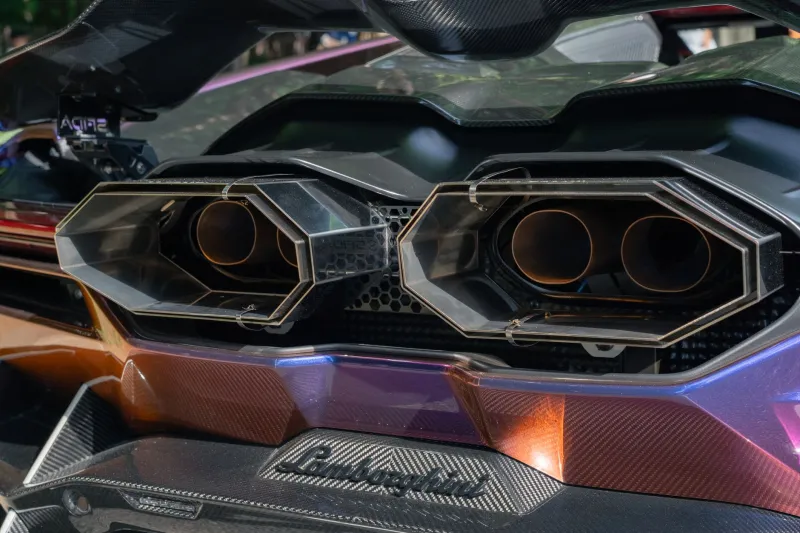
There is a moment, familiar to anyone who has stood near a Lamborghini Murciélago as its V12 clears its throat at idle, when the sound ceases to be mere noise and becomes something closer to a declaration. It does not whisper. It does not suggest. It announces. For decades, this sonic identity has been as central to Lamborghini's brand mythology as the raging bull emblem or the scissor doors—and among the community of American collectors who have built garages and, in some cases, entire lifestyles around these machines, the question of what that sound represents has never felt more urgent.
The Engineering Behind the Emotion
To understand why Lamborghini's engine acoustics carry such emotional weight, one must first appreciate the mechanical architecture that produces them. The naturally aspirated V12, which traces its lineage to Giotto Bizzarrini's original design in the 1960s, achieves its distinctive voice through a combination of high-revving displacement, individual throttle bodies, and an exhaust architecture that amplifies harmonic frequencies in a way that turbocharged engines fundamentally cannot replicate.
At wide-open throttle, a naturally aspirated V12 climbs through its rev range with a linearity that engineers describe as acoustically "honest." Every increment of throttle input corresponds to an immediate, proportional change in sound. There is no lag, no surge—just a continuous, ascending wail that peaks somewhere north of 8,000 rpm and, by most accounts, somewhere deep in the listener's chest. The Aventador SVJ, widely regarded as the apex of this particular sonic tradition, produces an intake roar that has been measured at levels approaching 100 decibels from the driver's seat at full chat.
The V10 found in the Huracán lineage operates on a similar principle, though its character differs meaningfully. Where the V12 screams with operatic intensity, the V10 delivers something rawer—a crackling, almost percussive note that many collectors describe as more aggressive, less refined, and entirely its own.
What Collectors Are Willing to Sacrifice
Speak to longtime Lamborghini owners across the United States, and a consistent theme emerges: the sound is not a feature. It is the feature. Collectors who have owned multiple examples of the marque frequently describe the acoustic experience as the primary variable in their purchasing decisions, sometimes overriding considerations of performance data, practicality, or even value retention.
This prioritization has real financial consequences. The market premium commanded by late-production, naturally aspirated Aventadors—particularly the Ultimae, the final expression of the V12 in that platform—reflects not just scarcity but a form of acoustic nostalgia that buyers are willing to pay handsomely to preserve. In American auction houses over the past three years, low-mileage Aventador SVJs have consistently outperformed initial projections, driven in no small part by collectors who recognize that the naturally aspirated V12 era is drawing to a close.
The calculus becomes more complicated when one considers the Huracán Tecnica and the Sterrato, both of which introduced a degree of acoustic augmentation through active exhaust systems and, in some configurations, synthetic sound enhancement. Reactions within the collector community have been decidedly mixed. Purists argue that any artificial amplification represents a philosophical compromise—that the integrity of the Lamborghini acoustic experience depends entirely on its authenticity. Others take a more pragmatic view, noting that tightening emissions regulations, particularly in California and other states that follow stricter environmental standards, have made some degree of acoustic engineering not merely acceptable but necessary.
The Turbo Question
No development in recent Lamborghini history has generated more sustained debate among American enthusiasts than the introduction of turbocharged power. The Urus, as an SUV, received a degree of ideological latitude that a sports car would not. But when Lamborghini confirmed that its next-generation V8, developed in partnership with Audi, would employ twin-turbocharging, the conversation shifted from theoretical to immediate.
The turbocharged engine is not without its own acoustic merits. The compressor whine, the blow-off valve flutter, the deep bass note produced by forced induction under load—these are sounds with their own enthusiast following, particularly among younger buyers who came of age with turbocharged performance as the default paradigm. The argument that turbocharged Lamborghinis cannot be sonically compelling is, in isolation, difficult to sustain.
The deeper concern, articulated by collectors who have followed the brand for decades, is one of identity continuity. Lamborghini's naturally aspirated engines have always sounded unmistakably like themselves. The fear is not that turbocharged engines sound bad—it is that they may not sound distinctly Lamborghini. In a market where brand differentiation is increasingly expressed through intangibles, the loss of a proprietary acoustic signature carries consequences that extend well beyond the emotional.
Electrification and the Silence Question
The question of electrification represents the most consequential chapter in this ongoing conversation. Lamborghini has confirmed that its future lineup will incorporate hybrid and eventually fully electric powertrains, a trajectory that mirrors the broader industry transition and satisfies regulatory demands that no manufacturer, regardless of heritage, can indefinitely resist.
The Lanzador concept, unveiled as a preview of Lamborghini's electric future, generated considerable interest for its design language. Its acoustic profile—or more precisely, the absence of one—generated considerably more anxiety. Electric motors are not silent; they produce a distinctive high-frequency whine that some designers have embraced as a new aesthetic vocabulary. Whether that vocabulary can carry the emotional authority of a naturally aspirated V12 at 8,500 rpm is a question that the industry has not yet answered convincingly.
Lamborghini's engineers have indicated that acoustic design will be treated as a primary engineering discipline in their electric vehicles, with significant investment directed toward creating a sound identity that is both authentic to the medium and consistent with the brand's heritage. The technical challenge is formidable. The cultural challenge may be greater still.
The Enduring Currency of Sound
What the debate around Lamborghini's sonic identity ultimately reveals is that sound functions, for this community, as a form of emotional currency—one that cannot be fully quantified but whose value is understood implicitly by everyone who participates in the market. The naturally aspirated V12's scream is not merely pleasant. It is a direct, unmediated connection to the philosophy that produced it: a philosophy of excess, of mechanical honesty, of performance pursued without apology.
American collectors, perhaps more than their counterparts elsewhere, have embraced this philosophy with particular fervor. In a culture that has always celebrated the theatrical, the outsized, and the unapologetically loud, Lamborghini's acoustic identity resonates with something deeper than automotive enthusiasm. It resonates with a particular idea of what ambition sounds like when it has been given 700 horsepower and permission to run.
Whether the brand can carry that resonance into an electrified future remains the defining question of this era. The answer, when it arrives, will be heard—or felt—long before it is understood.