The Collector's Calculus: Understanding Why Certain Lamborghinis Gain Value While Others Quietly Hemorrhage It
The mythology surrounding Lamborghini ownership in America tends to emphasize sensation over spreadsheets. The scissor doors, the howling engines, the unmistakable silhouette in a parking garage — these are the currencies of the brand's cultural appeal. Yet beneath the theater of ownership lies a financial reality that prospective buyers and current owners ignore at considerable peril.
The secondary market for Lamborghinis in the United States is, in truth, two entirely separate markets operating under the same nameplate. One rewards patience, specificity, and historical literacy with returns that rival — and occasionally surpass — traditional asset classes. The other extracts money from enthusiasts with a quiet efficiency that only becomes apparent when the consignment paperwork arrives at auction.
Understanding which category a given vehicle occupies requires a working knowledge of the variables that drive collector demand, and those variables are considerably more complex than simple production numbers.
The Appreciation Cohort: What Separates the Winners
The Lamborghini Miura occupies a position in automotive history that transcends marque loyalty. Produced between 1966 and 1973, the Miura is widely credited with establishing the mid-engine supercar configuration that remains the dominant template for high-performance vehicles half a century later. Concours-quality examples have achieved prices well in excess of two million dollars at major American auction houses, including Barrett-Jackson and RM Sotheby's. The appreciation trajectory has been consistent and substantial.
What made the Miura a collector's asset rather than merely an old car? Several converging factors: genuine historical significance, a production run of fewer than 800 units across all variants, a design by Marcello Gandini that has aged with extraordinary grace, and a cultural presence that extends far beyond the automotive community into fashion, film, and popular mythology.
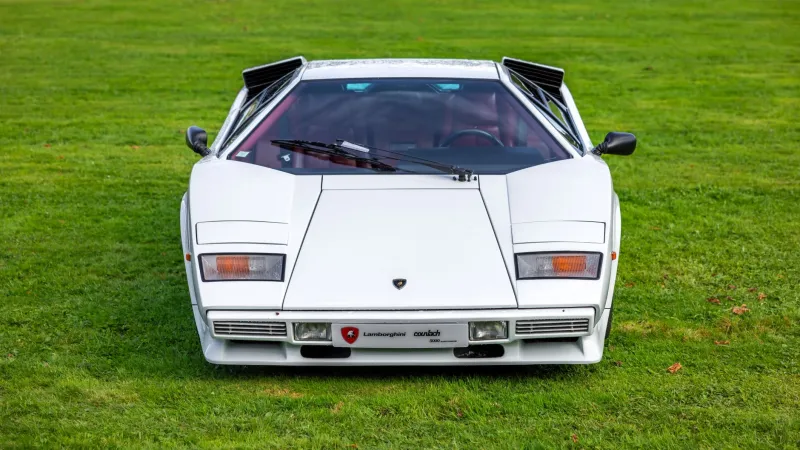
The Countach — particularly LP400 and LP400 S examples with correct Pirelli P7 tires and unmodified bodywork — followed a similar appreciation arc, though its peak collector interest arrived somewhat later. Early Countach values collapsed dramatically through the 1990s as the car shed its novelty, then recovered as a generation of buyers who had grown up with the poster on their bedroom wall achieved the financial means to acquire the object of their childhood fascination. This nostalgia-driven demand cycle is a recurring phenomenon in the collector car market and one worth monitoring for more recent Lamborghini generations.
Among contemporary models, the Aventador SVJ and the Huracán Performante have demonstrated meaningful value retention in the American market, driven by limited production allocations, documented performance credentials — the SVJ held the Nürburgring production car lap record at its introduction — and a level of mechanical purity that the market has begun to recognize as increasingly rare in an era of electrification.
The Depreciation Cohort: Where Optimism Meets Arithmetic
The standard Huracán LP 610-4, while an exceptional driver's car by any objective measure, occupies a more complicated position in the resale landscape. Produced in substantial numbers over a lengthy model cycle and offered without the performance differentiation or scarcity premium that drives collector interest, base Huracán examples have experienced depreciation curves that would be familiar to anyone who has tracked the value of a well-equipped German sports sedan.
The Gallardo, Lamborghini's most commercially successful model, presents a cautionary tale that prospective buyers should study carefully. Produced from 2003 to 2013 in configurations ranging from the entry-level coupe to the Superleggera and LP 570-4 Squadra Corse, the Gallardo flooded the American market with a volume that fundamentally altered the brand's exclusivity calculus. Base Gallardo coupes can now be acquired for prices that, adjusted for inflation, represent significant discounts from their original MSRP. Maintenance costs — which we will address shortly — compound the financial challenge for buyers who approach these vehicles as bargains.
The Murciélago occupies an interesting middle position. Standard coupe and roadster examples have depreciated substantially from peak values, while LP 670-4 SuperVeloce examples — produced in a total of 350 units globally — have appreciated meaningfully and continue to attract serious collector attention at auction.
The Maintenance Variable: The Hidden Multiplier
No analysis of Lamborghini resale economics is complete without an honest accounting of maintenance costs, which function as a persistent headwind against value retention for owners who do not budget accordingly.
The Gallardo's E-gear transmission — a single-clutch automated manual system that was state-of-the-art at its introduction but aged poorly relative to the dual-clutch systems that followed — has become one of the most financially significant ownership considerations in the pre-owned Lamborghini market. Clutch replacement intervals and the cost of actuator repairs have deterred buyers and suppressed values on otherwise desirable examples.
For Aventador owners, the ISR (Independent Shifting Rod) transmission presents analogous concerns. Buyers conducting due diligence on used Aventador examples should budget for transmission service costs that can reach into five figures, and they should request documented service histories from authorized Lamborghini dealers before finalizing any purchase.
Conversely, vehicles with complete, dealer-documented service histories command meaningful premiums in the American secondary market — premiums that are entirely rational from a buyer's perspective and that reward sellers who have maintained their vehicles with appropriate diligence.
Reading the Market: Practical Guidance for American Buyers
Several principles emerge from a careful examination of Lamborghini secondary market dynamics in the United States.
First, scarcity alone does not guarantee appreciation. The Reventón, produced in just twenty examples for road use, commands extraordinary values — but its rarity is inseparable from its historical position as the vehicle that established Lamborghini's modern design language. Scarcity in service of significance produces collector demand; scarcity in isolation produces curiosity.
Second, color and specification matter more than many buyers initially appreciate. Lamborghini's most iconic colors — Verde Mantis, Arancio Borealis, Giallo Orion — consistently outperform generic silver and gray specifications at auction. Buyers who select anonymous colors to maximize broad appeal frequently discover that the market disagrees with their logic.
Third, the limited-series and "Ultimae" designations have demonstrated genuine value-preservation characteristics in recent auction cycles. The Aventador Ultimae, as the final expression of a twelve-cylinder naturally aspirated lineage, carries historical weight that the market has already begun to price accordingly.
The secondary market for Lamborghinis rewards those who approach it as students of the marque rather than simply as buyers of fast automobiles. The difference in outcome — financial and experiential — can be considerable.