How the Raging Bull Rewired the American Supercar Psyche
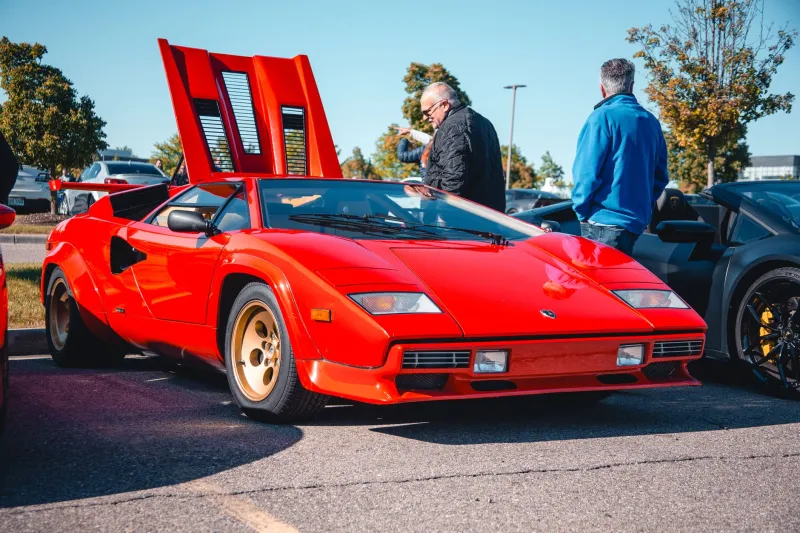
Long before horsepower figures became a cultural currency, Lamborghini taught American luxury car buyers that a vehicle could carry an attitude as powerful as its engine. The brand's uncompromising aesthetic philosophy didn't merely compete in the American market — it fundamentally restructured what buyers demanded from any machine wearing a prestige badge. Understanding that transformation reveals as much about American ambition as it does about Italian engineering.
A Different Kind of Arrival
When the Miura first reached American shores in the late 1960s, it landed in a market already comfortable with brute force. Detroit had spent the better part of a decade perfecting the muscle car — low, loud, and unambiguous in its intentions. What American buyers had not yet encountered was something that fused that aggression with a visual vocabulary so radical it seemed to belong to another era entirely.
Ferruccio Lamborghini was not interested in subtlety. His philosophy, born partly from a well-documented frustration with a rival marque's indifference to customer feedback, produced automobiles that treated restraint as a weakness. The wedge-shaped silhouettes, the scissor doors, the engines mounted in configurations that defied conventional wisdom — each decision communicated the same essential message: this machine was built on the manufacturer's terms, not the market's.
For American buyers conditioned to expect deference from luxury brands, that posture was genuinely disorienting. It was also, eventually, irresistible.
Attitude as Engineering
The critical insight that Lamborghini introduced to the American consciousness was the idea that visual aggression and mechanical capability were not separate considerations. In the pre-Lamborghini luxury landscape, a handsome automobile could be elegant, refined, even imposing — but rarely confrontational. The Countach changed that calculus permanently.
Its arrival in the mid-1970s created a generational imprint that is difficult to overstate. Poster art depicting the Countach decorated the bedrooms of a generation of American children who had no reasonable expectation of ever sitting inside one. That cultural saturation achieved something no advertising campaign could have manufactured deliberately: it embedded the Lamborghini design language into the aspirational imagination of an entire demographic.
Those children grew up. Many of them became the collectors, the entrepreneurs, the tech-industry founders who now populate the waiting lists at American Lamborghini dealerships. Their emotional relationship with the brand predates their financial capacity to act on it by decades. The aggression they encountered on those posters was not incidental to the appeal — it was the appeal.
Redefining the Competitor's Obligation
The downstream effect on rival manufacturers is difficult to quantify precisely, but it is unmistakable in retrospect. Prior to Lamborghini's cultural entrenchment in the American market, European luxury marques largely competed on dimensions of heritage, craftsmanship, and measured performance. Aggression was considered, at best, a secondary characteristic.
That calculus shifted considerably as American buyers began applying the Lamborghini standard — consciously or otherwise — to every high-performance vehicle they evaluated. Manufacturers who had previously positioned their products around composed, understated excellence found themselves under pressure to articulate a stronger personality. Exhaust notes grew more theatrical. Exterior designs adopted sharper angles. Brand communications leaned into confrontational language.
This was not coincidence. It was competitive response. The Lamborghini effect had established a new baseline for what American luxury performance buyers considered emotionally satisfying, and the broader industry was compelled to adjust accordingly.
The Psychology of the Collector
Among serious American collectors, the Lamborghini influence manifests in a particular psychological pattern that dealers and auction specialists have observed consistently over the past three decades. Buyers who gravitate toward the Sant'Agata product tend to resist the conventional collector's instinct toward preservation and passivity.
A significant portion of Lamborghini collectors in the United States drive their cars. They attend events. They engage with the machines in ways that owners of comparably valued automobiles from other marques frequently do not. This behavioral distinction traces directly to the brand's foundational philosophy: a Lamborghini that is not being driven is, in some meaningful sense, failing to fulfill its purpose.
That attitude — the insistence that a vehicle should be experienced rather than merely possessed — represents a cultural contribution that extends well beyond the supercar segment. It has influenced how American buyers across multiple price points think about the relationship between ownership and engagement.
Aggressive as Authentic
Perhaps the most durable legacy of Lamborghini's influence on American car culture is the equation it established between aggression and authenticity. In the decades since the Countach reshaped the visual expectations of the American market, a peculiar but consistent logic has taken hold among enthusiasts: a vehicle that pulls its punches aesthetically is a vehicle that is probably pulling its punches mechanically.
This is not a technically defensible position. Engineering excellence has never required angular bodywork or a confrontational stance. But as a cultural artifact, the assumption is deeply embedded, and Lamborghini planted it.
The brand accomplished this by consistently refusing to separate form from function in its public communications. Every design choice was presented as a performance decision. Every performance decision was reflected in the visual language of the car. Over time, American buyers absorbed that framework and began applying it universally.
The Inheritance
The manufacturers currently competing for the attention of American luxury performance buyers are, in a meaningful sense, competing within a framework that Lamborghini constructed. The expectation that a serious supercar must possess a distinct personality — not merely impressive specifications — is a standard that emerged directly from the brand's early influence on the American market.
This inheritance is most visible in the language buyers use when evaluating vehicles. Words like "presence," "attitude," and "statement" appear routinely in purchase decisions at price points where, a generation ago, buyers would have spoken primarily about reliability, heritage, and resale value. The vocabulary of aggression has become the vocabulary of aspiration.
For a brand that began as a tractor manufacturer's pointed response to a sports car rival, that cultural imprint represents an achievement that transcends any single model or any particular era of production. Lamborghini did not merely build fast cars for the American market. It taught the American market what fast cars were supposed to feel like — and the lesson has never really ended.