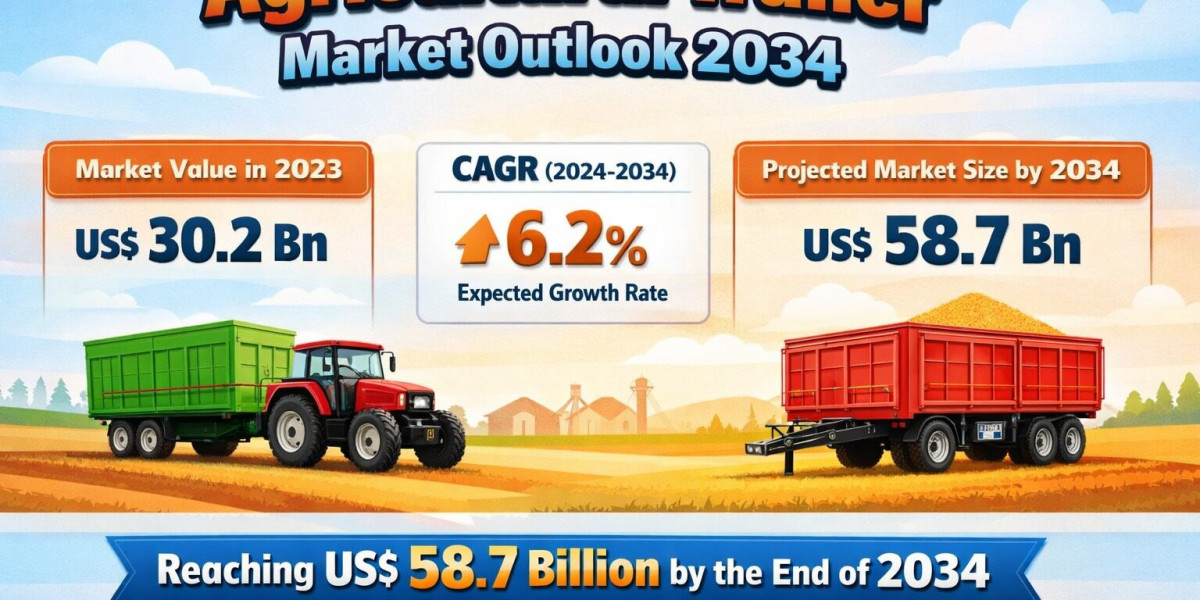

The Agricultural Trailer Market is entering a transformative decade marked by expanding agribusiness operations, rapid mechanization, and the modernization of rural infrastructure worldwide. Valued at US$ 30.2 billion in 2023, the market is projected to nearly double and reach US$ 58.7 billion by 2034, advancing at a compound annual growth rate (CAGR) of 6.2% from 2024 to 2034. This sustained growth underscores the critical role agricultural trailers play in supporting efficient farm logistics and large-scale food production.
As the global population continues to grow and dietary patterns shift toward higher consumption of grains, fruits, vegetables, and livestock products, agricultural output must increase correspondingly. However, scaling production requires more than land and labor—it demands integrated machinery ecosystems. Agricultural trailers are central to that ecosystem, ensuring that harvested crops, farm inputs, and heavy equipment are transported swiftly, safely, and cost-effectively.
The Expanding Importance of Farm Logistics
Modern agriculture operates as a highly coordinated supply chain. From seed distribution to harvesting and storage, each stage depends on timely transportation. Agricultural trailers provide the logistical backbone that connects field operations with storage facilities, processing plants, and distribution centers.
In the past, small-scale farms relied on manual handling or basic transport carts. Today, commercial agriculture demands high-capacity, rugged, and hydraulically efficient trailers capable of handling large volumes under demanding conditions. Whether transporting harvested grains during peak season or distributing fertilizers across expansive fields, trailers directly influence productivity and turnaround time.
Farmers are increasingly recognizing that improved transport efficiency reduces crop loss, enhances profitability, and strengthens overall farm resilience.
Market Drivers Strengthening Demand
1. Escalating Global Food Requirements
The steady rise in global population is intensifying pressure on agricultural systems. Governments and private stakeholders are prioritizing food security, which translates into increased cultivation intensity and expanded farmland utilization.
Higher production volumes mean larger harvest loads, and managing those loads efficiently requires reliable transport equipment. Agricultural trailers enable faster movement of bulk commodities, minimizing delays and ensuring optimal storage conditions. As global food demand grows, the requirement for advanced transport solutions grows alongside it.
2. Rapid Mechanization of Farming Practices
Mechanization has become a defining feature of 21st-century agriculture. Farmers are investing in high-performance tractors, combine harvesters, sprayers, and planting equipment. Agricultural trailers complement these machines by ensuring smooth logistical support.
Mechanized farming reduces dependency on manual labor while improving yield consistency. Trailers equipped with advanced hydraulic systems streamline unloading processes, particularly during time-sensitive harvest periods.
Precision farming techniques further amplify this trend. Specialized trailers designed for transporting fertilizers, pesticides, and seeds help maintain accurate input application, enhancing crop output and resource efficiency.
3. Technological Advancements in Trailer Design
Innovation in materials and engineering has significantly enhanced trailer performance. Modern agricultural trailers now feature:
Reinforced steel frames for durability
High-efficiency hydraulic tipping systems
Corrosion-resistant coatings
Advanced suspension mechanisms for uneven terrain
Multi-axle configurations for improved load distribution
Such technological upgrades ensure longer service life and lower maintenance costs, making trailers a strategic investment for commercial farmers.
Product Type Analysis
The Agricultural Trailer Market is segmented into several product categories:
Flatbed Trailer
Grain Wagon
Dump Trailer
Sprayer Trailer
Tipping Trailer
Non-Tipping Trailer
Three-Way Tipping Trailer
Others
Dump Trailer: The Leading Segment
Among these, the dump trailer segment accounted for the largest revenue share in 2023 and is forecast to grow at a CAGR of 6.6% through 2034.
Dump trailers are favored for their versatility and ease of unloading. Hydraulic lifting mechanisms enable quick discharge of materials such as grains, soil, manure, and fertilizers. This efficiency reduces downtime and increases daily operational capacity.
Their heavy-duty construction allows them to operate effectively on rugged terrain, making them suitable for both small and large farms.
Grain Wagons and Three-Way Tipping Trailers
Grain wagons remain indispensable in cereal-producing regions. With large-capacity bins and durable wheel systems, they facilitate efficient crop transport from fields to storage facilities.
Three-way tipping trailers are gaining popularity due to their flexible unloading capabilities, which improve operational convenience in confined or irregular field environments.
Segmentation by Tractor Type
Agricultural trailers are designed to align with different tractor types:
Utility Tractor Trailer
Orchard Type Tractor Trailer
Garden Tractor Trailer
Row Crop Tractor Trailer
Others (Compact Tractors)
Utility and row crop tractor trailers dominate market demand, reflecting their widespread use in large-scale agricultural operations.
As tractors with higher horsepower ratings become more common, trailer manufacturers are responding with reinforced designs capable of handling heavier loads and increased stress.
Compact tractor trailers are expanding in popularity among smallholder farmers and specialty crop producers.
Capacity and Axle Configuration Insights
Capacity segmentation includes:
Less than 2 tons
2 to 8 tons
Above 8 tons
The 2 to 8-ton segment holds substantial market share due to its adaptability across farm sizes. However, trailers exceeding 8 tons are increasingly adopted by commercial agribusinesses handling bulk production.
Axle configuration significantly impacts load stability:
Single Axle
Double Axle
Multi Axle
Double and multi-axle trailers are preferred for heavy-duty operations, ensuring safer transport and improved load balance.
Application Segmentation
The Agricultural Trailer Market serves multiple applications:
Farm
Forestry
Others
Dominance of the Farm Segment
The farm segment accounted for the majority revenue share in 2023. Agricultural trailers are indispensable for daily farm activities, including crop transport, livestock movement, and machinery relocation.
Harvest season logistics, in particular, demand reliable trailers capable of minimizing delays and preventing spoilage.
Forestry applications are also witnessing steady growth, driven by demand for durable trailers capable of transporting logs and timber across uneven terrains.
Regional Outlook
Asia Pacific: Market Leader
Asia Pacific emerged as the leading regional market in 2023 and is expected to maintain its dominance throughout the forecast period.
Key factors driving regional growth include:
Expanding agricultural production in countries such as China and India
Government incentives promoting mechanization
Improved rural infrastructure
Growing awareness of advanced farming technologies
The region’s agricultural diversity requires multiple trailer types, fueling broad-based demand.
North America and Europe
North America and Europe are mature markets characterized by high mechanization rates. Farmers prioritize technologically advanced trailers with enhanced load capacity and durability.
Replacement demand and product upgrades contribute significantly to regional revenue.
Central & South America and Middle East & Africa
These regions present emerging opportunities as agricultural modernization accelerates. Increasing mechanization rates and supportive government policies are gradually expanding trailer adoption.
Competitive Landscape
The Agricultural Trailer Market is fragmented, with the top 10 players accounting for approximately 20%–30% of global revenue. This fragmentation encourages competition and innovation.
Leading companies focus on:
New product development
Strengthening distribution networks
Enhancing load capacity
Collaborating with OEMs
Expanding into emerging markets
Recent product introductions emphasize higher load-bearing capabilities and advanced hydraulic efficiency to meet the demands of modern agriculture.
Challenges Impacting Market Growth
Despite strong prospects, the market faces certain constraints:
High initial capital investment
Volatility in raw material prices
Fluctuations in agricultural commodity markets
Limited access to financing in rural areas
However, supportive government policies and technological advancements are expected to mitigate these challenges over time.
Future Opportunities
Several growth opportunities lie ahead:
Integration of smart technologies such as load sensors
Lightweight material innovation for fuel efficiency
Expansion into underserved emerging markets
Customization for precision agriculture applications
As agriculture becomes increasingly data-driven, agricultural trailers are likely to evolve into more intelligent and integrated transport systems.
Long-Term Market Perspective
The Agricultural Trailer Market is positioned for sustained expansion through 2034. Rising food demand, expanding mechanization, and infrastructure development will continue to propel growth.
Manufacturers that prioritize durability, hydraulic efficiency, and technological innovation will be best positioned to capture emerging opportunities. Additionally, strategic partnerships and enhanced financing options will broaden market accessibility.
In an era defined by agricultural transformation, trailers are no longer peripheral equipment—they are strategic assets that directly impact farm productivity and supply chain efficiency.