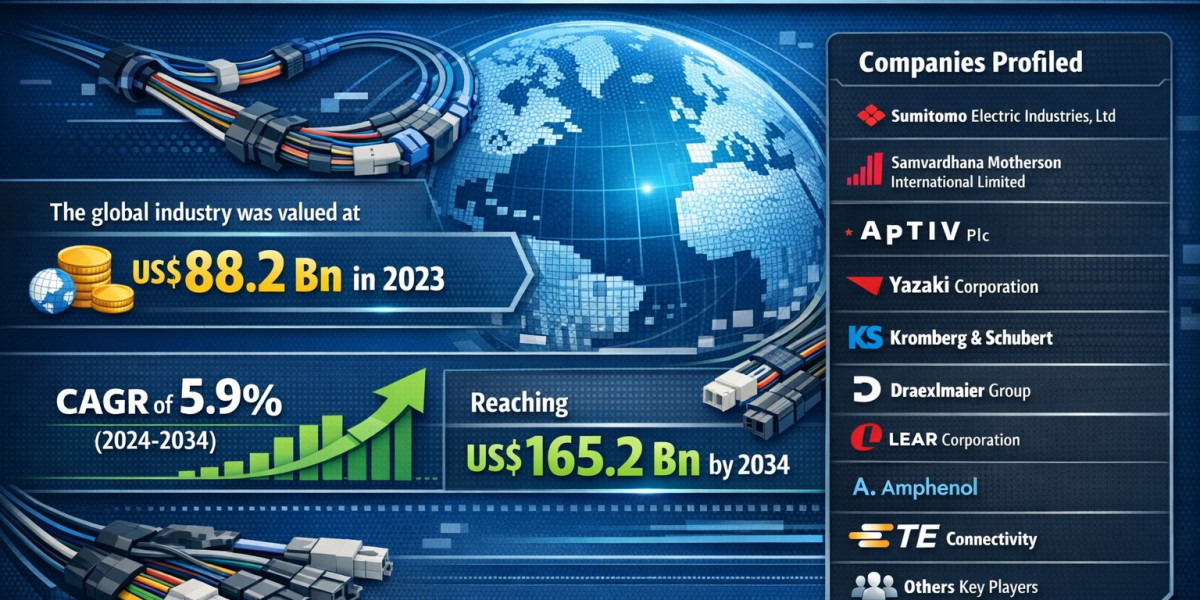

The global wire harness market is poised for steady and sustained growth over the next decade, supported by rising electrification trends across industries. Valued at US$ 88.2 Bn in 2023, the market is projected to reach US$ 165.2 Bn by the end of 2034, expanding at a compound annual growth rate (CAGR) of 5.9% from 2024 to 2034.
The industry’s expansion is being driven by increasing demand from automotive, aerospace, industrial automation, renewable energy, and consumer electronics sectors. As digitalization and electrification deepen across global industries, wire harness systems have become critical components in ensuring seamless electrical connectivity, power distribution, and signal transmission.
Analyst Viewpoint
The wire harness market size is being significantly influenced by the expansion of automotive and aerospace industries, rapid technological advancements, and the accelerating trend of vehicle electrification. The global surge in electric vehicles (EVs) and advanced driver-assistance systems (ADAS) is acting as a key catalyst for market growth.
Additionally, the widespread adoption of automation and robotics in manufacturing processes is increasing the demand for complex and reliable wiring solutions. Smart factories, Industry 4.0 initiatives, and IoT-enabled systems require sophisticated electrical interconnections — a role efficiently fulfilled by wire harness systems.
However, the industry faces certain challenges, including fluctuating raw material prices and stringent regulatory standards. Rising copper and polymer costs can impact production margins, while compliance with safety and environmental regulations adds operational complexity.
On the positive side, the revival of global industries and rising preference for eco-friendly and energy-efficient products are strengthening long-term market prospects. Leading players are investing heavily in research & development to develop lightweight materials, recyclable components, and advanced high-voltage harnesses. Strategic collaborations and mergers are further enhancing competitive positioning across global markets.
Market Introduction
A wire harness is an organized assembly of electrical cables and wires that transmits signals and electrical power. In automotive applications, it connects electronic control units (ECUs), sensors, batteries, actuators, and other electrical and electronic (E/E) components.
The wiring harness ensures effective energy and data flow within the vehicle’s E/E architecture, enabling primary functions such as steering and braking, as well as secondary functions such as ventilation, infotainment, and lighting systems.
Beyond automotive applications, wire harnesses are widely used in aerospace systems, renewable energy installations, medical devices, industrial equipment, and consumer electronics. Their ability to bundle multiple wires into a structured system improves safety, reduces installation time, and enhances durability.
Key Market Drivers
Surge in Adoption of Industrial Automation Bolstering Wire Harness Market Revenue
Industrial automation is rapidly transforming manufacturing processes worldwide. Automation involves the use of control systems such as computers, robotics, and information technologies to manage industrial operations with minimal human intervention.
This shift significantly increases the demand for efficient and reliable wiring solutions. Automated machinery and robotic systems require intricate electrical interconnections to ensure seamless power distribution and signal communication.
Wire harnesses provide structured cable management solutions, reducing clutter and minimizing downtime. As industries pursue higher productivity and operational efficiency, the integration of automated systems continues to intensify.
The rise of smart factories and Industry 4.0 ecosystems — characterized by interconnected machines, IoT devices, and real-time data exchange — further increases the complexity and volume of wiring requirements. Wire harness systems play a crucial role in maintaining system integrity and operational reliability.
The automotive industry, a major consumer of industrial automation technologies, further accelerates demand. Modern vehicles incorporate numerous automated and electronic features, significantly increasing harness complexity.
Additionally, wire harness systems contribute to improved safety standards, reduced maintenance costs, and enhanced energy efficiency — all of which are vital to industrial competitiveness.
Expansion of Renewable Energy Driving Market Development
The rapid expansion of renewable energy projects, including solar farms and wind energy installations, is another major driver of the wire harness market.
Renewable systems rely on complex electrical connections to link components such as inverters, batteries, transformers, and grid interfaces. Wire harnesses ensure efficient and safe transmission of electrical power and signals in these environments.
Solar panels require reliable wiring solutions to connect photovoltaic modules and storage systems. Wind turbines depend on robust harnesses capable of withstanding harsh environmental conditions, including temperature fluctuations and mechanical vibrations.
The global push toward decarbonization and cleaner energy sources is increasing investments in renewable infrastructure. As grid integration becomes more complex, advanced wire harness solutions capable of high-performance transmission and durability are becoming essential.
Moreover, innovations in electric vehicles (EVs) and energy storage systems — both integral to the renewable energy ecosystem — are further fueling market growth. EVs require sophisticated high-voltage harnesses for battery management, power distribution, and electronic control systems. Energy storage installations also depend on reliable harness systems for battery connectivity and power management.
Regional Outlook
Asia Pacific Leads Global Market
Asia Pacific held the largest share of the global wire harness market in 2023 and is expected to maintain its dominance during the forecast period.
The region benefits from rapid industrialization, infrastructure expansion, and strong growth in automotive manufacturing. Countries such as China, Japan, South Korea, and India have established robust automotive and electronics manufacturing ecosystems.
The increasing adoption of industrial automation across Asia Pacific is strengthening regional demand. Additionally, strong economic growth and favorable government policies are encouraging investments in electric vehicles and renewable energy projects.
The expansion of automotive production hubs and rising exports further contribute to Asia Pacific’s leadership in the wire harness market.
Other regions, including North America and Europe, are also experiencing steady growth, supported by advanced aerospace industries, EV penetration, and renewable energy investments.
Competitive Landscape and Key Players
The global wire harness market is highly competitive, with leading players focusing on innovation, expansion, and strategic partnerships.
Prominent companies include:
- Sumitomo Electric Industries, Ltd
- Samvardhana Motherson International Limited
- Aptiv Plc
- Yazaki Corporation
- Kromberg & Schubert
- Draexlmaier Group
- Lear Corporation
- LEONI AG
- Amphenol
- TE Connectivity
These companies are expanding their global footprint and investing in R&D to develop lightweight, recyclable, and high-voltage harness solutions tailored for EVs and advanced aerospace systems.
Key Market Developments
In May 2024, Yazaki Corporation partnered with Toray Industries, Inc. to introduce recycled PBT resin for automotive wiring harness connectors. This innovation utilizes leftover production materials, enhancing sustainability within the automotive supply chain.
In September 2023, Draexlmaier Group opened a new 800-volt battery production facility in Leipzig, Germany. This move strengthens its position in high-voltage battery systems and supports EV expansion.
In December 2022, Aptiv Plc completed the acquisition of Wind River, enhancing its capabilities in intelligent edge software systems and secure mobility solutions.
Market Segmentation Highlights
The wire harness market is segmented based on:
Application:
Automotive (including EVs, trucks, motorbikes), aerospace, defense, marine, medical devices, gaming machines, industrial automation, power & energy, consumer electronics, agricultural equipment, elevators & escalators, and others.
Sales Type:
OEM and Aftermarket.
Among these, the automotive segment remains dominant due to increasing electrification and integration of advanced electronic systems in vehicles.
Conclusion
The global wire harness market is entering a transformative decade, driven by electrification, automation, renewable energy expansion, and digital connectivity. With the market expected to nearly double in value from US$ 88.2 Bn in 2023 to US$ 165.2 Bn by 2034, industry participants are strategically positioning themselves to capitalize on emerging opportunities.
As EV adoption accelerates, smart factories expand, and renewable energy infrastructure grows, demand for advanced, durable, and sustainable wire harness systems will continue to rise — shaping the future of electrical connectivity across industries worldwide.