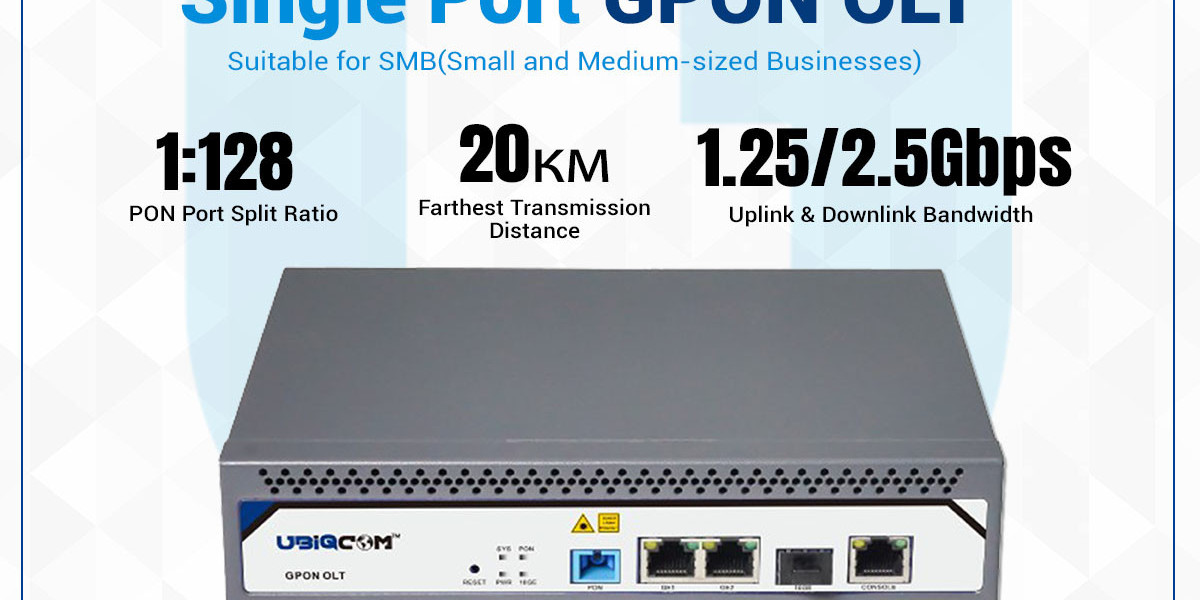

As fiber-based broadband continues to expand, service providers are constantly looking for cost-effective and flexible ways to deploy high-speed networks. Among the various solutions available, the Single Port OLT stands out as a compact yet powerful option designed for targeted fiber deployments. It is especially suitable for small-scale networks, pilot projects, and areas where demand is growing steadily rather than all at once.
Understanding Single Port OLT
A Single Port OLT is an Optical Line Terminal equipped with one PON (Passive Optical Network) port. It functions as the central control unit in a fiber access network, managing communication between the service provider’s core network and multiple optical network units installed at the subscriber end. Despite having a single PON interface, it can support multiple end users through passive optical splitters, making it an efficient choice for focused deployments.
Unlike large, multi-port chassis-based systems, single port OLTs are compact, easy to install, and require minimal infrastructure. This simplicity makes them ideal for environments where space, power, and budget constraints are key considerations.
Key Features and Capabilities
Single port OLT devices are built to deliver enterprise-grade performance in a smaller form factor. They typically support advanced traffic management, VLAN configuration, QoS policies, and secure authentication mechanisms. Many models also offer web-based management interfaces, allowing operators to configure and monitor the network without complex tools.
In terms of capacity, a single PON port can serve dozens of subscribers depending on the split ratio and bandwidth planning. This allows service providers to deliver high-speed internet, voice, and IPTV services over a single fiber infrastructure.
Role in FTTH and FTTB Deployments
In FTTH and FTTB scenarios, single port OLTs play a crucial role in extending fiber connectivity to residential buildings, small communities, business parks, and remote locations. They are particularly effective for projects where subscriber density is low to moderate, or where the network is expected to expand gradually.
By starting with a single port OLT, operators can roll out services quickly and scale later by adding more units or upgrading to higher-capacity systems as demand increases. This modular approach reduces upfront investment while ensuring long-term flexibility.
Cost Efficiency and Operational Benefits
One of the biggest advantages of single port OLTs is their cost-effectiveness. Lower hardware costs, reduced power consumption, and simplified maintenance make them attractive for small ISPs and regional service providers. Since these devices often support plug-and-play deployment, installation time is significantly reduced.
Operationally, they simplify network management by limiting complexity. With fewer ports and configurations to manage, troubleshooting becomes easier, leading to faster issue resolution and improved service reliability.
Performance and Network Reliability
Despite their compact design, single port OLTs are designed to deliver stable and reliable performance. They support modern PON standards such as GPON, ensuring high bandwidth availability and efficient data transmission. Advanced features like dynamic bandwidth allocation help optimize network resources, ensuring fair and consistent service quality for all connected users.
Many devices also include redundancy options for power or uplinks, enhancing network uptime and reliability even in challenging environments.
Ideal Use Cases
Single port OLTs are well-suited for a variety of deployment scenarios. These include rural broadband initiatives, smart city edge deployments, temporary network setups, and enterprise campuses. They are also commonly used for testing and demonstration purposes before scaling to full-sized OLT systems.
For service providers entering new markets or expanding into underserved areas, a single port OLT offers a low-risk entry point without compromising on service quality.
Conclusion
A single port OLT is a practical and future-ready solution for service providers seeking efficient fiber network deployment. Its balance of performance, scalability, and affordability makes it an excellent choice for targeted broadband rollouts. By adopting this approach, operators can deliver reliable high-speed services today while keeping their networks ready for tomorrow’s growth.