Pulling the Plug: Why America's Most Devoted Lamborghini Collectors Are Choosing Simplicity Over Silicon
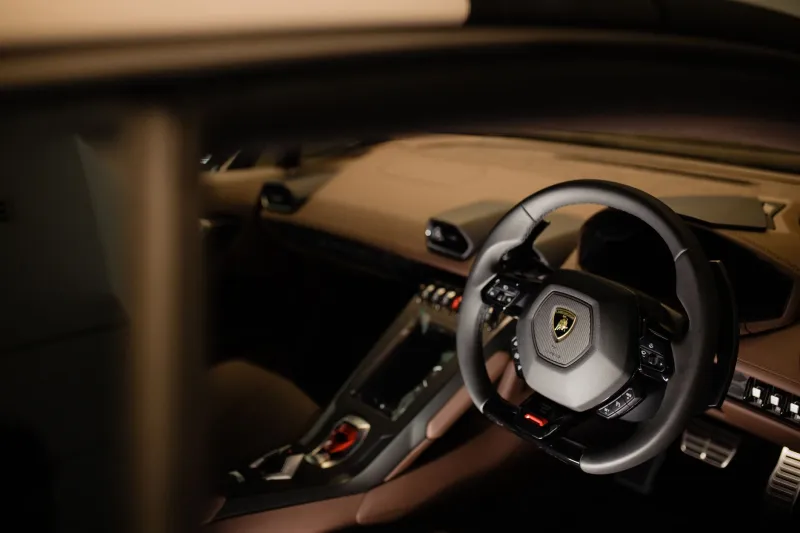
There is a particular kind of silence that settles over a serious collector when he is asked about the touchscreen in his new car. It is not the silence of someone searching for words. It is the silence of someone who has already made up his mind and is deciding how bluntly to say so.
Across the United States, a cohort of Lamborghini enthusiasts — men and women who have owned multiple examples of Sant'Agata's finest, who have logged track days and cross-country runs and garage hours that most people will never accumulate — are reaching a quiet but firm conclusion. The more technology Lamborghini installs in its automobiles, the less those automobiles feel like Lamborghinis.
This is not nostalgia in the sentimental sense. It is a considered, often carefully articulated position about what a supercar fundamentally is, and what it risks becoming.
The Accumulation of Assistance
To understand the backlash, one must first appreciate how dramatically the driving experience has shifted over the past fifteen years. The Lamborghini of 2024 is, by nearly any objective measure, a more capable machine than the Lamborghini of 2005. It is faster, safer, more refined, and more consistent. It is also, critics argue, more managed.
Modern Lamborghini models arrive laden with torque vectoring systems, lane departure warnings, adaptive cruise control, and infotainment architectures that require firmware updates. The Huracán's LDVI system — Lamborghini Dinamica Veicolo Integrata — processes data from every major vehicle system and intervenes in real time, adjusting behavior before a driver has registered that an adjustment was needed. The Urus, which has become the brand's volume leader in the American market, adds a further layer of SUV-specific driver assistance technology that would have seemed extraordinary in a luxury sedan a decade ago.
For casual owners and new buyers, these systems represent genuine value. They lower the barrier to entry. They make a five-hundred-horsepower automobile manageable on a Tuesday afternoon in traffic. Nobody disputes this.
But for the collector who wants to feel every conversation between tire and tarmac — who considers the act of correcting a slide not a failure to be prevented but a skill to be exercised — each layer of electronic mediation is experienced as a dilution.
The Pre-2010 Premium
The market has begun to reflect this sentiment in ways that are difficult to ignore. Pre-2010 Lamborghinis, particularly the Gallardo in its earlier naturally aspirated configurations and the later-generation Murciélago, have attracted sustained collector interest that goes beyond simple nostalgia or rarity premiums. Buyers are specifically seeking these cars for their relative mechanical directness.
The Gallardo LP560-4, the Murciélago LP640, and especially the final Murciélago LP670-4 SuperVeloce occupy a particular sweet spot: modern enough to be genuinely fast and drivable, old enough to predate the most aggressive wave of electronic intervention. These are cars in which the driver's inputs translate into vehicle behavior with a fidelity that enthusiasts describe, almost uniformly, as honest.
Dealers in major American markets — California, Texas, Florida — report that the buyers most likely to pay a premium for low-mileage pre-2010 examples are not first-time Lamborghini owners. They are experienced collectors trading laterally or downward in terms of horsepower figures, making a deliberate choice to accept less raw performance in exchange for more direct communication.
Disabling the Machine
For those who prefer to remain within the current lineup, a secondary practice has emerged: systematic disablement of the technology that came with the car. This ranges from the straightforward — switching off lane-keeping assist and automatic emergency braking through the vehicle's settings menu — to the more involved, including the use of third-party modules that allow drivers to configure stability control parameters beyond what the factory menus permit.
The practice exists in a complicated legal and warranty gray area, and it is not one that Lamborghini's authorized dealer network encourages. Nevertheless, it is widespread enough that it has generated its own informal economy of knowledge, shared through enthusiast forums and private communities where experienced owners compare notes on which systems can be safely modified and which should be left alone.
The motivation is consistent across nearly every account. Owners want to know what the car is doing. They want to feel the limit approach rather than have it managed away. They want, in a phrase that recurs with striking regularity in these conversations, to drive the car rather than supervise it.
A Philosophical Divide
It would be a mistake to frame this as straightforwardly anti-technology. Many of the same collectors who disable their stability control are deeply interested in the engineering that makes modern Lamborghinis function. They read technical documentation. They understand the systems they are switching off. Their objection is not to technology in the abstract but to a specific application of it: technology deployed in service of making the driver less consequential.
There is a meaningful distinction, these enthusiasts argue, between technology that enables a driver — better brakes, improved aerodynamics, more precise suspension geometry — and technology that replaces driver judgment. The former enhances the relationship between human and machine. The latter substitutes for it.
This is a philosophical position with a long tradition in automotive culture, and it is one that Lamborghini's own history supports. The brand was built on the premise that a car should make demands of its driver. The early Countach was not forgiving. The Diablo was not gentle. These were machines that required something from the person behind the wheel, and that requirement was considered a feature, not a deficiency.
What Lamborghini Faces
For the brand itself, this tension represents a genuine strategic challenge. The regulatory environment in the United States — and globally — is moving in one direction. Safety mandates, emissions requirements, and the gradual approach of electrification are all pushing toward greater software integration, not less. Lamborghini cannot simply opt out of this trajectory.
And yet the brand's most passionate constituency is sending a clear signal. The collectors who evangelize on behalf of Lamborghini, who introduce new buyers to the marque, who sustain the community that gives the brand its cultural weight — these are precisely the people most likely to feel alienated by the direction modern development is taking.
The hybrid Revuelto, which replaces the Aventador, is the most powerful production Lamborghini ever built. It is also the most electronically complex. Whether it satisfies the analog purists or deepens their conviction that the pre-electrification era represents a high-water mark is a question the market will answer in the years ahead.
The Ghost That Remains
What the collectors who are turning back toward simpler machines are chasing is not easy to quantify. They use words like rawness, purity, and honesty. They describe the experience of driving an unassisted Lamborghini at its limit as something that cannot be replicated by a more capable but more managed successor.
There is a ghost in the machine, and it is the ghost of consequence. The knowledge that the car will do precisely what the driver asks, no more and no less, and that the driver is therefore responsible for the outcome. That is the sensation these collectors are paying to preserve.
In a culture increasingly oriented toward the elimination of friction, the removal of risk, and the optimization of every experience, there is something quietly radical about a group of serious, informed enthusiasts choosing the harder thing on purpose. They are not rejecting progress. They are insisting on a particular definition of what progress, in the context of a Lamborghini, ought to mean.